
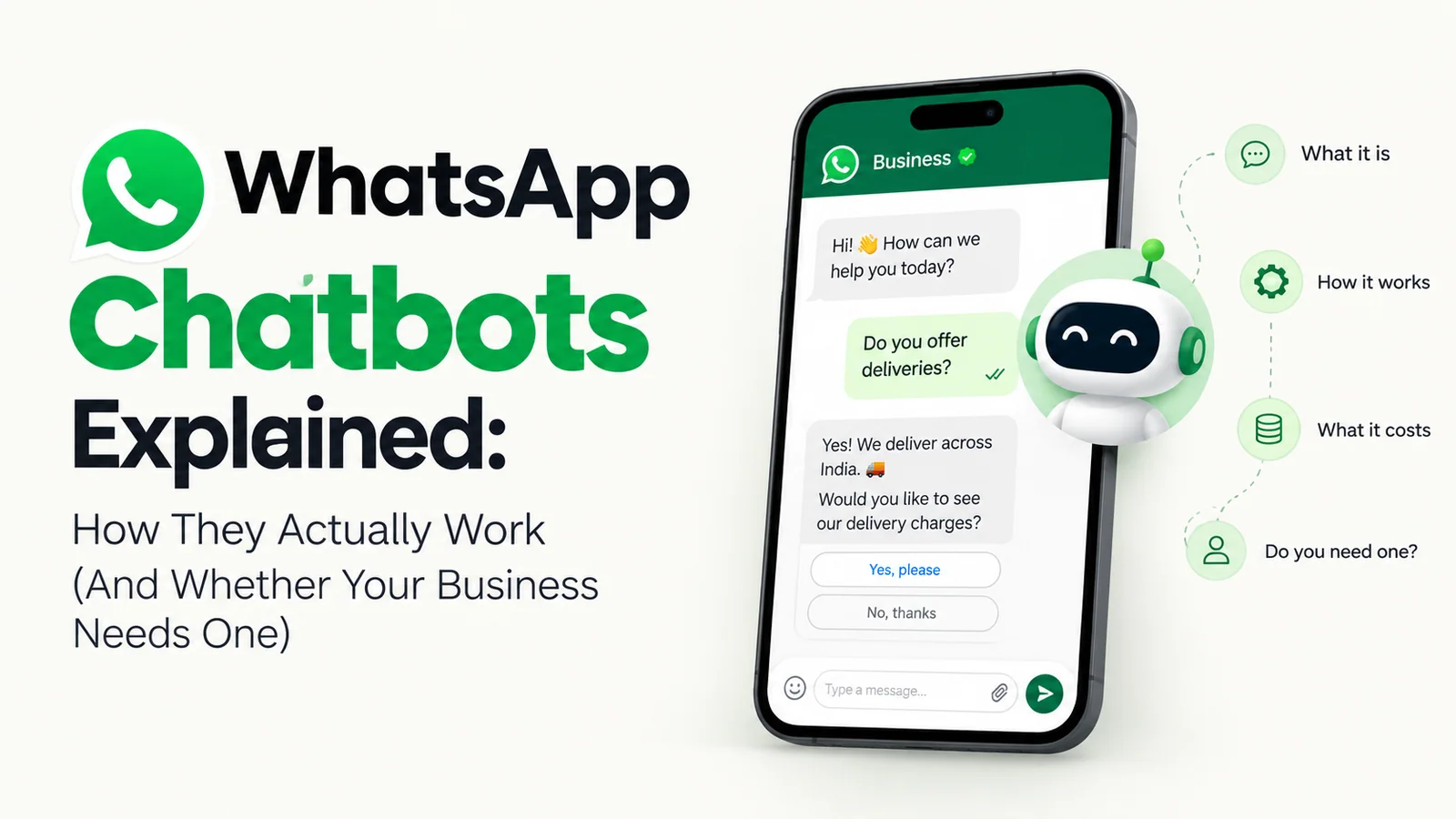
WhatsApp Chatbots Explained: How They Actually Work (And Whether Your Business Needs One) A few months back, a salon owner in Lucknow asked me a question that stuck with me: "Bhaiya, yeh chatbot wala cheez, yeh kya jaadu hai?" (This chatbot thing — what kind of magic is this?)
It's not magic. But I get why it feels that way. One day you're manually replying to "what time do you open" for the fortieth time that week, and the next day someone tells you a piece of software can handle that, book the appointment, and even follow up — all while you're asleep.
If you've been hearing about WhatsApp chatbots everywhere — from your competitor's Instagram story to a cousin who "just automated his whole shop" — and you still don't fully understand what they are, this guide is for you. No jargon dump. No sales pitch dressed up as an article. Just a straight explanation of what these things are, how they work, and whether one actually makes sense for a business like yours.
What Is a WhatsApp Chatbot, Really?
At its simplest, a WhatsApp chatbot is a program connected to a WhatsApp number that can read incoming messages and respond automatically, without a human typing the reply in real time.
That's the textbook definition. But it undersells what's actually happening in 2026, because "chatbot" now covers two very different kinds of technology, and mixing them up is where most confusion starts.
The old kind: rule-based bots. These work off decision trees. Customer types "1" for pricing, "2" for support, "3" to talk to a human. You've almost certainly dealt with one of these and found it frustrating — because the moment you type something the bot wasn't explicitly programmed to expect, it breaks. "I don't understand that. Please choose from the options below." Sound familiar?
The new kind: AI-driven conversational agents. These are built on large language models (the same family of technology behind tools like ChatGPT) connected to your business's actual data — your services, your pricing, your appointment slots, your FAQs. Instead of matching keywords, they understand intent. A customer can type "kal shaam ko free ho kya" (are you free tomorrow evening) in Hinglish, with typos, out of order, and the system still understands what's being asked and responds naturally, in context, like a well-trained staff member would.
The gap between these two is enormous, and it's the single biggest reason some businesses see chatbots as a gimmick while others see them as the best hire they never had to pay a salary to.
How a WhatsApp Chatbot Actually Works, Step by Step
Here's the part most explanations skip — the actual mechanics.
-
The WhatsApp Business API connection. A chatbot doesn't run on the regular WhatsApp app you have on your phone. It connects through the WhatsApp Business Platform (formerly called the WhatsApp Business API), which is Meta's official channel for businesses to send and receive messages programmatically. This connection has to be set up through Meta or an approved provider, and it's what allows automated messages to flow in and out legally and reliably.
-
The message comes in. A customer messages your business number — "Is this available in blue?" or "Can I book a slot for Saturday?"
-
The system reads intent, not just words. A well-built bot doesn't scan for the word "book" and fire a template reply. It processes what's being asked, checks it against your actual business information — your product list, your calendar, your pricing sheet, your policies — and works out the right response.
-
It responds like a person would. Ideally, this reply doesn't read like a robot. "Yes, available in blue! Would you like me to hold one for you or share more details?" — not "OPTION 1: BLUE. OPTION 2: RED."
-
It takes the next action. This is where it stops being a glorified FAQ page and starts being genuinely useful — booking the appointment directly into your calendar, sending a payment link, tagging the lead in your CRM, or looping in a human team member if the conversation needs a real person.
-
It follows up. The best systems don't just answer and disappear. They can nudge an interested customer who went quiet, send a reminder before an appointment, or check in after a purchase — the kind of follow-up almost no small business actually has the bandwidth to do consistently by hand.
Why WhatsApp Specifically?
There's a reason nobody's writing this same article about "Instagram DM chatbots" with the same urgency. WhatsApp holds a different place in how people communicate, especially across India, the Middle East, Latin America, and much of Southeast Asia.
A few numbers worth sitting with: WhatsApp has over 500 million users in India alone, and open rates on WhatsApp messages routinely run above 90%, compared to email open rates that hover around 20%. People check WhatsApp the way they check who's calling — almost involuntarily. A message sitting in someone's WhatsApp inbox gets seen. An email sitting in their promotions tab usually doesn't.
For a business, that changes the math entirely. It's not just another channel to automate — it's the channel your customers are already living in.
What Businesses Are Actually Using These For
This isn't theoretical. Here's where WhatsApp chatbots are doing real work right now:
Clinics and healthcare practices — handling appointment booking, sending pre-visit instructions, answering "do you accept this insurance" without a receptionist picking up the phone between patients. Salons and spas — managing slot bookings, sending reminders that cut down no-shows, and answering pricing questions after hours when the shop is closed but the phone never stops buzzing. Real estate — qualifying leads instantly ("what's your budget, which locality, 2BHK or 3BHK") instead of a broker manually screening every inbound inquiry. D2C and retail brands — confirming orders, sharing tracking updates, and handling "is this in stock" questions that would otherwise flood a support inbox. Service businesses generally — anyone whose sales process starts with "someone asks a question" and ends with "someone books a slot or makes a payment."
The common thread isn't the industry. It's the pattern: repetitive questions, time-sensitive replies, and a business owner or small team that's stretched too thin to answer every message within the golden window — which, on WhatsApp, is often measured in minutes, not hours.
The Honest Downsides (Because Every Article Skips These)
I build these for a living, and I'd be doing you a disservice if I only told you the good parts.
Setup isn't instant. A genuinely good chatbot needs to be trained on your actual business — your services, your tone, your edge cases. A rushed setup with generic responses is worse than no bot at all, because customers can tell.
It's not "set and forget." Your services change, your pricing changes, your seasonal offers change. A bot that isn't updated becomes a bot that gives wrong answers, and wrong answers on a channel customers trust do real damage.
It won't replace human judgment for everything. Complaints, sensitive situations, and genuinely unusual requests still need a human. The businesses that get the most value treat the bot as the first responder, not the only responder — it handles the repetitive 80%, and hands off the nuanced 20% to a real person.
Cheap, generic bots hurt more than they help. There's a flood of template-based "WhatsApp bots" that technically work but feel exactly like the frustrating "Reply 1 for Sales" menus everyone already hates. If a bot makes your business feel less human, it's the wrong bot.
So — Does Your Business Actually Need One?
Ask yourself three honest questions:
Are you (or your team) answering the same handful of questions dozens of times a week? Do leads go cold because nobody replied fast enough — especially outside working hours? Is manually booking, confirming, and reminding customers eating time you could spend actually running the business?
If you answered yes to even two of these, a WhatsApp chatbot isn't a "nice to have" — it's closing a leak that's probably costing you customers right now, quietly, in a way that doesn't show up on any dashboard.
If you answered no to all three, you might genuinely be fine without one for now. Not every business needs to automate everything, and a chatbot bolted onto a business that doesn't need it is just noise.
A Quick Note From Us
We build these systems day in and day out at Expansio — mostly for small and mid-sized businesses across India who were tired of losing customers to slow replies, and didn't want their business to sound like a robot in the process. If this piece raised more questions than it answered, or you're curious what one of these would actually look like for your specific business, our WhatsApp AI agent page walks through it in more detail. No pressure either way — half the point of writing this was to make the confusing stuff make sense, whoever ends up building your solution.
Frequently Asked Questions
Is a WhatsApp chatbot the same as WhatsApp Business app? No. The free WhatsApp Business app (the green app with a briefcase icon) is a manual tool for small businesses — you still type every reply. A chatbot connects through the WhatsApp Business API and can respond automatically, at scale, without someone typing in real time.
Do I need coding knowledge to set one up? Not as a business owner. You'll need either a technical team or an agency to build and connect it, but running and updating it day-to-day is usually designed to be simple for non-technical staff.
Will customers know they're talking to a bot? With well-built AI-driven bots, often not immediately — and that's by design. The goal isn't to trick anyone; it's to respond so naturally and helpfully that it doesn't matter. Most systems are also built to disclose it's automated when directly asked, and to hand off to a human whenever needed.
Is it expensive? It varies widely — from low-cost template bots to fully custom AI agents. The right way to think about cost isn't "what does it cost" but "what is a missed lead currently costing me," and comparing from there.
Can it work in Hindi or Hinglish? Good AI-driven bots — as opposed to older rule-based ones — can handle Hinglish, regional phrasing, and typos naturally, which matters enormously for businesses serving Indian customers.