
Key takeaways ✺
- A property enquiry that sits unread for even a few hours is often already talking to another agent. The fix is reply speed, not more leads.
- The top-ranking real-estate WhatsApp bots, PropPilot, SimpleListings, Kubalabs, are foreign SaaS tools priced in USD with no India context. They're built for a market that isn't yours.
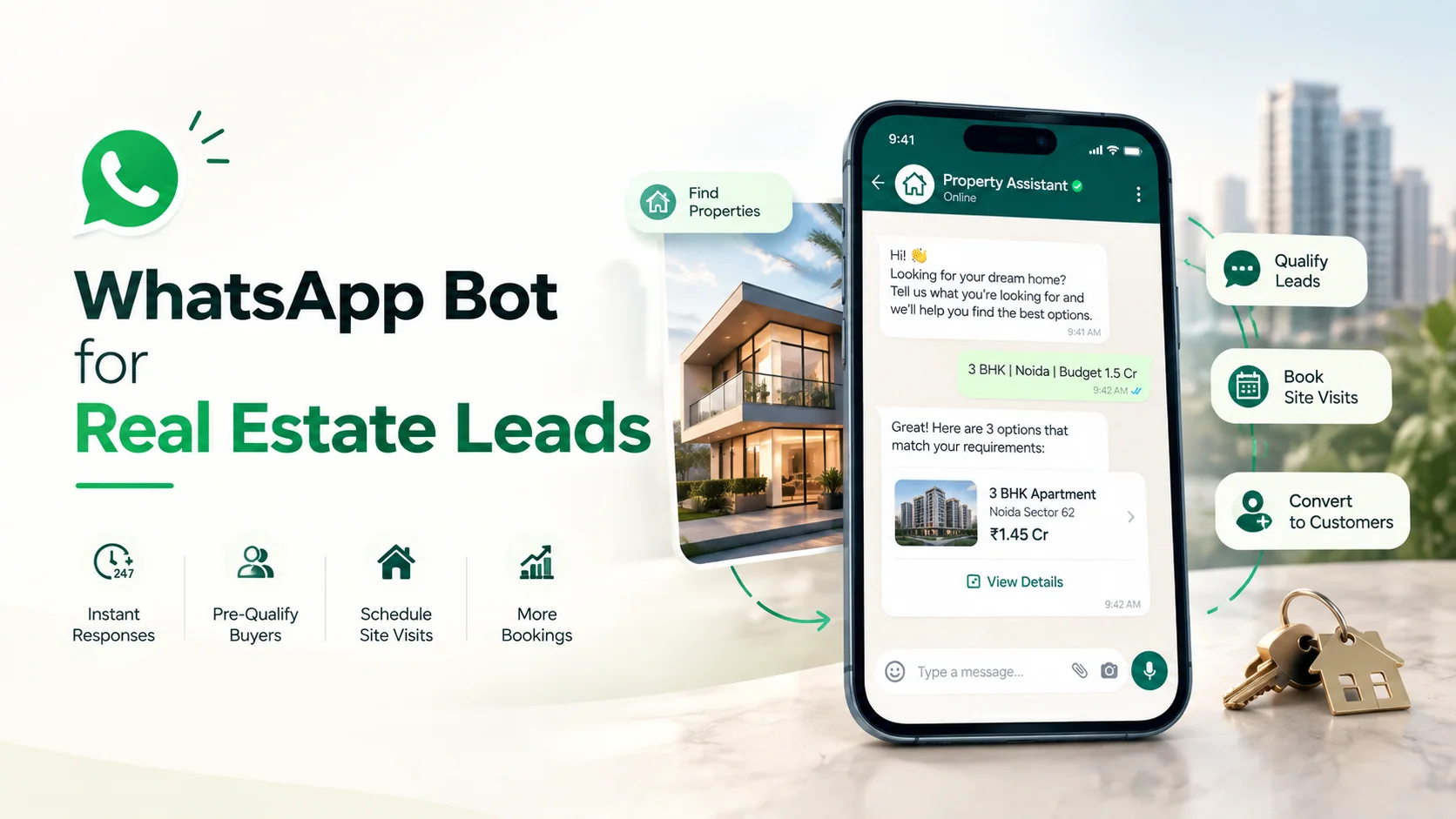
- A done-for-you agent replies in seconds, shares your brochure and floor plans, qualifies budget, and books site visits, all on your own WhatsApp number, not a new login.
- One residential-project case study saw site visits go from ~18 to 71 a month and junk leads reaching the sales team drop 72% after adding a WhatsApp booking bot.
- You can build a basic manual version yourself with WhatsApp Business's free quick replies and away messages. It just can't hold a real conversation, or follow up on its own.
It's 9:40pm on a Sunday. Someone's been scrolling your listing on 99acres for twenty minutes, comparing floor plans in six other tabs, and finally taps "Message on WhatsApp" under your number. They ask if the corner 2BHK is still available and whether Saturday works for a visit.
You're at dinner. You see it Monday morning at 9am. By then, they've already messaged four other agents who had the exact same flat listed. That happens because builders often hand the same inventory to more than one agent at a time. One of those four replied Sunday night. You didn't lose the lead because your price was wrong or your unit wasn't good enough. You lost it because someone else's phone buzzed back faster.
This is the actual problem behind "whatsapp bot for real estate leads" as a search term. It isn't about needing more leads. Most agents already have more enquiries than they can answer promptly. The portals see to that. It's about not being the third or fourth reply on a conversation where only the first one usually gets a callback.
Why replying fast matters more in real estate than almost anywhere else
A property enquiry is rarely exclusive. The same buyer who messages you about a listing has usually messaged two or three other numbers for the same project, or is actively comparing your listing against five others in the same locality and budget band. There's no loyalty yet. There's no relationship yet. There's just whoever answers a specific, answerable question first: is it available, what's the price, can I see it this weekend.
We're not going to hand you a made-up percentage here. A lot of the "78% of buyers pick whoever replies first" style stats floating around real-estate blogs trace back to nobody in particular. What we can point to is a real, verified example. A residential project we worked with rebuilt the whole path from ad click to site visit: a landing page that filtered out browsers before they reached WhatsApp, and a booking bot inside the chat itself that offered visit slots and sent automatic reminders at 24 hours and 2 hours before the visit. Site visits went from around 18 a month to 71. Junk leads reaching the sales team dropped 72%, and the cost of getting one lead worth actually calling fell 41% compared with their previous launch. Read the full case study →
None of that came from a smarter ad. It came from nobody having to wait for a human to be free before getting an answer.
Honestly, you might not need this yet
If you're getting three or four enquiries a week and you're glued to your phone anyway, a paid automation tool is solving a problem you don't have. Reply fast yourself, save a few templated answers as WhatsApp quick replies, and put the money into ads or a better listing photo shoot instead. This is genuinely built for the point where enquiries start outnumbering the hours you have to answer them one at a time. That's usually once you're juggling more than one active project, running your own portal ads, or covering site visits solo without anyone at a desk to answer while you're out.
What the foreign SaaS tools get wrong for an Indian broker
Search "whatsapp bot for real estate leads" and most of the results, tools like PropPilot, SimpleListings and Kubalabs, work the same way. They're SaaS tools, which just means software you log into and pay a subscription for rather than something built around you, and they're dashboard-first: priced in dollars, and designed around a US or global real-estate workflow. A few things trip up an Indian agent trying to actually use one:
- You're billing in USD on an Indian income. Every payment goes through a currency conversion before it even reaches your books. On top of the sticker price, your bank also charges a forex markup, its own fee for converting rupees to dollars.
- It's one more login, not a fix to the one you already check. Your buyer is already on WhatsApp. Now you also have to open a separate dashboard to check what the bot did, instead of just seeing the answer where the conversation already happened.
- Nothing about it understands the Indian buying journey. No sense that "site visit," "token amount," or "loan sanction" mean anything specific, and nothing built around Hindi or Hinglish, which is how a large share of these conversations actually happen.
- Support runs on a US or European clock. If something breaks on a Saturday when you actually need it live, you're waiting for a time zone.
None of this makes them bad tools. They're just built for a different market, and an Indian solo agent or small brokerage ends up paying dollar pricing for features designed around a workflow that was never theirs.
What an auto-reply for property enquiries should actually do
Strip away the dashboards and this is the actual job: answer instantly, ask the two or three questions that separate a real buyer from a browser, and get a visit on the calendar without you touching the phone.
- Replies in seconds, any hour. The 9:40pm message gets answered at 9:40pm, not 9am Monday.
- Shares your brochure, floor plans and price list on request, so nobody's manually forwarding the same PDF fifteen times a day.
- Qualifies budget before it ever reaches you, so you're not spending twenty minutes on someone who was never in range.
- Books the site visit. It offers weekend slots, confirms, and sends a reminder, so the visit lands on your calendar instead of staying buried three messages deep in a chat you forgot to reopen.
- Follows up on quiet leads. The buyer who went silent after asking about pricing gets a polite nudge a few days later. That's the kind of follow-up almost nobody actually does by hand, consistently.
- Hands over to you the moment it's out of its depth, whether that's negotiation or a site-specific concern. Anything that actually needs your judgment gets flagged straight to you, not bluffed through.
- Sends you a daily summary: who asked, what they wanted, who's booked, so you're not reconstructing the day's enquiries from memory before your first call.
That's the version worth paying for. Anything short of that is a fancier away-message.
The DIY version, and where it stops working
You can build a rough version of this yourself for free, and it's worth trying before you pay for anything. In the WhatsApp Business app: turn on a Greeting message for anyone messaging you for the first time or after 14 days of silence, set an Away message for outside your working hours, and build three or four Quick Replies for the questions you get on repeat, something like "Yes, available. Price is ₹X. Want to book a visit?" triggered by a shortcut like /price.
Add Labels to tag chats as "New enquiry," "Site visit booked," "Not interested" so you can filter your chat list at a glance instead of scrolling. If you have listings across a few projects, the Catalog feature lets you attach a price list buyers can browse without you sending anything.
This genuinely covers a slow week. Here's where it breaks. None of it reads what the buyer actually typed. It only fires on exact keyword matches or a blanket time-based trigger, so anything phrased slightly differently gets nothing, or the wrong canned reply. It can't ask a follow-up question based on what someone said. It won't nudge a lead that's gone cold three days later; remembering that is still on you. And it can't actually hold a booking slot or send a reminder. It just puts a message in a thread you still have to track yourself. That gap, between sending a message and actually understanding and handling the enquiry, is the whole difference between a quick-reply setup and an AI agent trained on your specific listings.
What it actually costs
A WhatsApp AI agent trained on your listings, running on your own WhatsApp Business number, costs ₹2,000 a month. Pay for the year upfront instead and it's ₹14,999, which works out to roughly ₹1,250 a month. There's no setup fee. It's built and live within 7 days of you sending over your project details, prices and floor plans, and it's a monthly subscription you can cancel any time with no lock-in. Beyond that, the only extra cost is Meta's own per-conversation charge, typically a few rupees per chat depending on volume, billed at actuals rather than marked up.
For a solo agent or a two-to-three person brokerage, that's less than what you'd spend on a single day of portal ads, for something that answers every enquiry those ads generate: day, night, and the Sunday everyone else is offline.
Where this fits if you're already running portal ads or Meta ads
If you're running click-to-WhatsApp ads on Meta (Facebook and Instagram), or your budget goes toward portal listings that route enquiries into WhatsApp, this is the piece that stops that spend from leaking. Every rupee spent getting someone to tap "Message us" is wasted the moment that message sits unread for three hours. The agent makes sure the click and the reply happen in the same minute, whether it's three enquiries that day or thirty.
It doesn't replace you closing the actual sale. It replaces the two hours a day you'd otherwise spend answering "is this still available" and "what's the price," so the calls you do take are ones actually worth having.
What's actually slowing your replies down right now: too many enquiries, or just nobody free when the message comes in?
Questions people also ask
Can a WhatsApp auto-reply actually understand a property enquiry, or does it just send a canned message?
It depends on what you build. The free WhatsApp Business app can only fire fixed away messages and quick replies triggered by keywords; it can't follow an actual conversation. An AI-trained agent reads the message itself, replies in context, asks qualifying questions like budget, and hands off to you the moment it's out of its depth.
Will buyers get suspicious if a bot replies instead of the agent?
Not if it's built right. The agent runs on your existing WhatsApp Business number, speaks in your voice (English, Hindi or Hinglish, mirroring the buyer), and is upfront the moment a question needs a human. Something like "let me get [agent name] on this" converts better than a bot pretending to be a person.
Does this work for a single agent, or only for a big brokerage with a CRM?
It's built for the opposite case, one person or a small team handling enquiries between site visits, without the time to also learn a CRM (the software bigger agencies use to track every buyer and deal). There's no separate login. Leads and a daily summary land in the same WhatsApp you already use.
What does a WhatsApp auto-reply for real estate cost in India?
A done-for-you agent trained on your listings runs ₹2,000 a month (or ₹14,999 billed annually, working out to roughly ₹1,250/month), with no setup fee and a 7-day build. That's the whole cost beyond Meta's own per-conversation charges, which are typically a few paise to a few rupees per chat.
Can it actually book a site visit, not just answer questions?
Yes. Offering weekend slots, confirming the visit and sending a reminder is a standard part of the flow, not a custom add-on. It lands in your calendar instead of sitting in a WhatsApp thread you have to remember to check.