
Key takeaways ✺
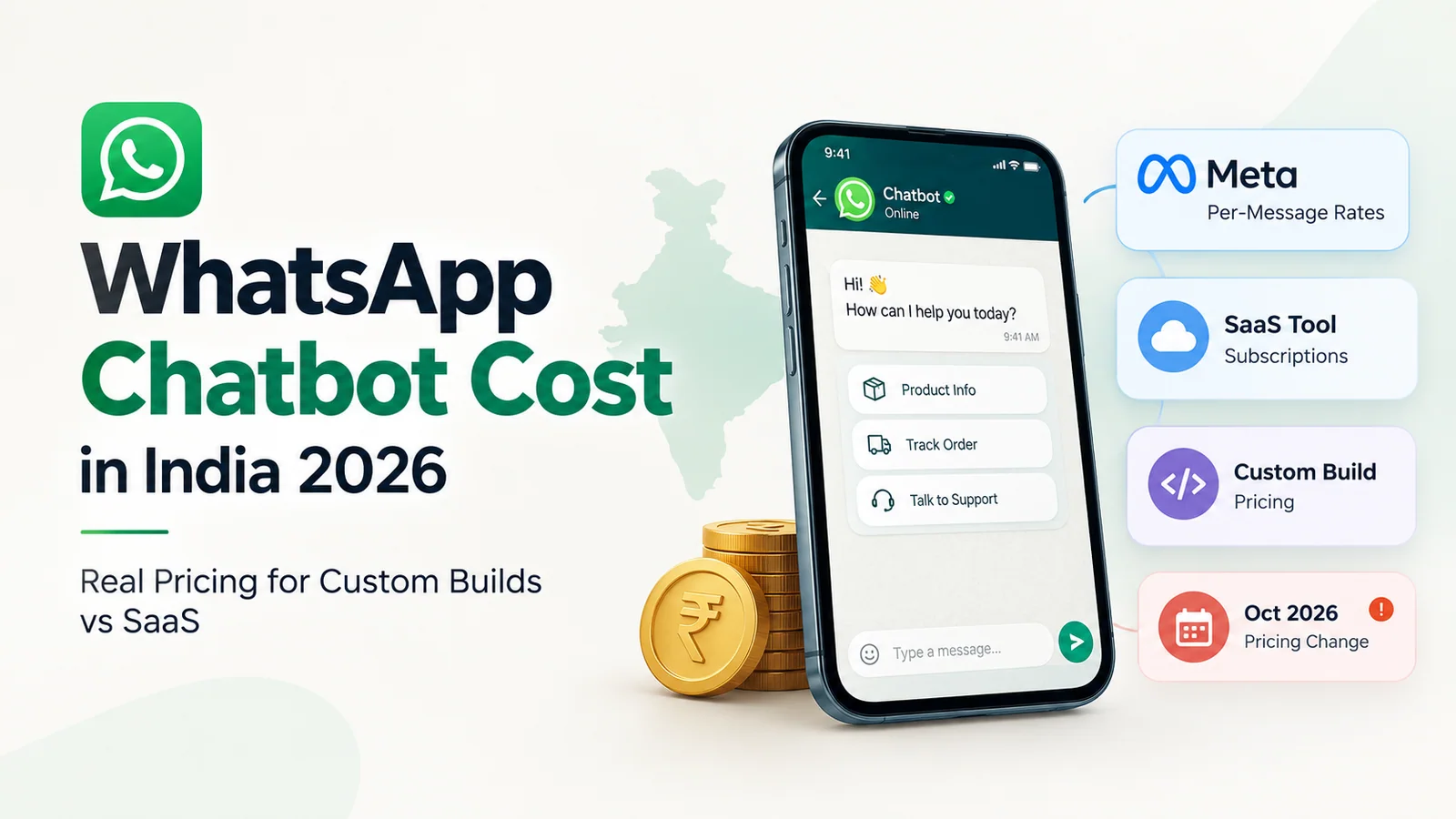
- Meta stopped charging per conversation in July 2025. Now you pay per message sent, split into marketing (~₹0.86–0.88), utility (~₹0.11–0.13), and authentication (~₹0.11–0.13) categories, billed at India-specific INR rates.
- From 1 October 2026, free-form "service" replies inside the 24-hour window stop being free too. Each business number gets 1,000 free service messages a month, then pays the utility rate after that.
- No-code SaaS tools (AiSensy, WATI, Interakt and similar) run roughly ₹1,500–₹6,000/month in platform fees alone, before Meta's per-message charges land on top.
- A custom-built bot with booking flows, CRM sync, and human handoff typically costs ₹40,000–₹2,00,000+ one-time, plus a smaller monthly fee. It's not worth it for a business that just needs an FAQ auto-reply.
- Expansio's own WhatsApp Agent is priced at ₹2,000/month (or ₹14,999/year), with Meta's usage charges billed at actual cost. That's a useful anchor point when a vendor quotes you a number with no breakdown.
It's 9 pm and you're staring at a vendor's WhatsApp bot pitch that says "starting from ₹999/month." Somewhere else in the same browser tab, another vendor wants ₹1.5 lakh to build you one. Both of them are technically telling the truth, and neither one has told you why the numbers are eleven times apart.
That gap is the whole problem with searching "WhatsApp chatbot cost India" right now. Almost every result either hides behind "contact us for a quote," or throws out one number with zero context. Nobody mentions what Meta itself charges you separately. Nobody explains what pushes a build from ₹40,000 to ₹2 lakh. And nobody actually answers the question you're asking: what will this cost me, specifically, for my business?
This post breaks all of that down properly: real per-message rates from Meta's current pricing model, real ranges from actual SaaS tools and agency builds, and the specific things that push you toward one end of each range or the other. No number here is invented. Every figure is checked against a current source, and we've flagged the one big pricing change, arriving October 2026, that most "2026 pricing guide" posts online still haven't caught up with.
The two costs nobody separates
Every WhatsApp chatbot has two completely different bills. Vendors routinely blur them together to make their number look smaller than it is.
Cost one: Meta's usage charges. This is what WhatsApp itself charges for every message your business sends through the official WhatsApp Business Platform (it used to be called just "the API"). Meta bills this directly, in Indian rupees for Indian businesses. No vendor controls this number. They can only add a markup on top of it.
Cost two: the platform or build cost. This is what you pay a SaaS tool (a monthly subscription) or an agency (a one-time build fee, sometimes plus a smaller monthly retainer) to actually design, host and run your bot's conversation logic on top of Meta's infrastructure.
A quote that only mentions one of these two numbers isn't a real quote. It's half of one. Keep that split in mind through the rest of this post, because it's also how the actual maths works.
What Meta itself charges you (verified against current pricing)
Here's the part that changed under everyone's feet, including a lot of pricing pages still floating around online.
Until 30 June 2025, Meta billed WhatsApp usage per conversation. That meant one flat fee for a 24-hour window, no matter how many messages passed through it. On 1 July 2025, that model ended. Meta now bills per message. Every template message gets billed individually the moment it's delivered, based on its category and which country the recipient is in.
For Indian businesses, the current template categories and rates are roughly:
| Category | Used for | Approx. rate per message (India) |
|---|---|---|
| Marketing | Offers, promotions, festive-sale broadcasts, re-engagement pings | ₹0.86–₹0.88 |
| Utility | Order updates, appointment reminders, payment confirmations | ₹0.11–₹0.13 |
| Authentication | OTPs, login codes | ₹0.11–₹0.13 |
| Service (free-form replies) | Anything your bot or team types back inside an open chat | Free, up to a monthly limit — see below |
A few things worth knowing before you do your own maths:
- Marketing messages cost roughly six to seven times more than utility or authentication ones. If your bot's main job is answering "what are your timings" and "is this in stock," you're mostly in the cheap utility/service lane. If you're running a broadcast list for a festive sale, that's the expensive marketing lane, and it adds up fast at volume.
- Replies inside an open 24-hour window have been free. This is what Meta calls a "service" conversation. If a customer messages you first, your bot or your team can reply as many times as needed inside that window at no charge. That's why reactive bots, the kind that only answer when asked, are so much cheaper to run than broadcast-heavy ones.
- India got its own local pricing in January 2026. Meta shifted Indian accounts to straight rupee billing instead of a dollar rate that got converted at billing time. It's a small change, but a useful one if your invoice used to swing around with the exchange rate.
Here's the change that matters most right now, and it's landing in about two weeks. From 1 October 2026, those free-form "service" replies inside the 24-hour window stop being unconditionally free. Meta is giving every business phone number 1,000 free service messages a month. Anything beyond that gets billed at the same rate as a utility message, roughly ₹0.11 to ₹0.13 each.
For a small single-location business, 1,000 messages a month is often enough. That works out to over 30 conversational replies a day. If your WhatsApp desk is busier than that, it's worth counting your current monthly reply volume before October. This is the first time in over a year that a "free" line on your bill starts costing something.
One more thing: Meta has said a payment method needs to be on file by 30 September 2026, or service messages simply stop going out on 1 October. Check this with whoever manages your WhatsApp Business account, no matter which pricing tier you're on.
Honestly, for most single-location businesses, like a clinic, a boutique, or a small real estate office, Meta's own usage bill lands somewhere between ₹200 and ₹2,000 a month once you factor in the free allowance and a message mix that's mostly utility and service. It's the platform or build cost, not Meta's charges, that decides most of what you actually pay.
What a no-code SaaS chatbot tool costs
If you've searched around, you've seen names like AiSensy, WATI, and Interakt come up as "WhatsApp Business Solution Providers," or BSPs. These are companies that give you a dashboard, a flow builder, and access to Meta's platform, without needing a developer on staff.
Checking current vendor pricing pages directly: AiSensy's published plans start around ₹1,500/month for essential features, with a Pro tier around ₹3,200/month that unlocks broadcast scheduling and analytics. WATI prices in US dollars. Its tiers run roughly $59 to $279/month depending on the plan and billing cycle, which converts to somewhere between ₹5,000 and ₹24,000/month at current rates, noticeably higher than the India-priced tools once you do the conversion. Other Indian BSPs cluster in a similar ₹2,000–₹6,000/month band for their mid-tier plans.
None of those numbers include Meta's per-message charges. Those get billed on top, either passed through at cost or with a markup added. Some BSPs add 15–35% on top of Meta's rate, so ask directly what markup, if any, applies before you sign up.
So realistically, a no-code SaaS chatbot costs somewhere between ₹1,500 and ₹6,000/month in platform fees, plus Meta's usage charges on top. For a moderate-volume, single-location business, that usually adds another few hundred to a couple thousand rupees. All in, most small businesses land somewhere in the ₹2,000–₹8,000/month range on a SaaS tool.
What you get for that: a visual flow builder where you drag boxes instead of writing code, a shared team inbox, broadcast lists, basic analytics, and a chatbot that handles branching FAQ-style conversations reasonably well. What you generally don't get: deep custom logic, real-time backend integration with your own systems, or a conversation that feels built for you rather than built from a template.
What a custom-built WhatsApp bot costs
This is where agency quotes start swinging wildly, and it's almost always because "custom build" means very different things to different people.
A simple custom bot, with a few conversation flows, basic branching, and a connection to a spreadsheet or a simple database, can be built for as little as ₹15,000–₹40,000 one-time. Template approval and BSP setup usually add a few thousand rupees on top of that.
A truly custom build is a different story. This is a bot with multi-step booking flows, two-way sync with a CRM or hospital management system, human handoff that routes to the right team member, more than one language running in the same conversation, or an AI layer that can understand free-text questions instead of just reading button taps. Build that, and you're realistically looking at ₹40,000 to ₹2,00,000+ as a one-time development cost. On top of that comes a monthly fee for hosting, maintenance, and retraining, which is usually smaller than an equivalent SaaS subscription, because you're not paying for features you don't use.
What actually drives that number up
The spread between ₹40,000 and ₹2 lakh isn't arbitrary. These are the specific things that move a quote up:
- Multi-step conversation flows with real branching logic: not "press 1 for X," but a flow that remembers context across ten messages and adapts based on earlier answers.
- CRM or backend integration: this means the bot writes a booking directly into your existing system, whether that's Zoho, a custom database, or a hospital OS, instead of just messaging a human to enter it manually.
- Human handoff done properly: not just a "type HELP" command, but the bot recognising frustration or a question outside its scope and routing to the right person with the full chat history attached, so the customer doesn't have to repeat themselves.
- Multi-language support: running Hindi, English, and a regional language smoothly in one flow costs meaningfully more than English-only, because every message template needs writing, testing, and approval in each language.
- WhatsApp Business API approval and BSP setup: getting your Meta Business Manager verified, your display name approved, and your BSP account provisioned isn't instant, and agencies typically build a setup fee into the first invoice to cover this work.
- Payment collection inside the chat: generating and tracking payment links, reconciling them against orders, and handling failed payments is a real chunk of build work on its own, separate from just chatting.
- AI/LLM usage: if the bot uses an AI model to understand open-ended text rather than button taps, there's a token cost behind every AI-generated reply, and that scales with your conversation volume, not your subscription tier.
A bot that does none of this (pure FAQ auto-reply, no integrations, no AI) has no business costing ₹2 lakh. A bot that does all of it has no business costing ₹40,000. Ask any vendor which of these your quote actually includes before you compare it to anyone else's number.
SaaS vs custom build: a real cost comparison
| No-code SaaS tool | Custom build | |
|---|---|---|
| Upfront cost | ₹0–₹5,000 (setup fee, if any) | ₹15,000–₹2,00,000+ |
| Ongoing cost | ₹1,500–₹6,000/month platform fee | Often ₹2,000–₹15,000/month retainer, sometimes less than SaaS |
| Meta usage charges | Billed separately either way, per message sent | |
| Setup time | Same day to a few days | 1–4 weeks depending on complexity |
| Best for | FAQs, catalogue sharing, simple bookings, one or two languages | CRM sync, multi-step booking, human handoff, multi-language, AI-driven replies |
| Ceiling before you outgrow it | Hits a wall once you need real backend logic | No practical ceiling, but you paid for headroom you might not use yet |
For reference, here's where a mid-market, done-for-you option sits between these two extremes. Expansio's own WhatsApp Agent is priced at ₹2,000/month, or ₹14,999/year, which works out to under ₹1,250/month. Meta's actual usage charges get billed at cost, with no markup added and no lock-in contract. It sits closer to the custom-build end in what it does: trained on your specific business, with booking, catalogue, and human handover built in. But it's priced closer to the SaaS end, because the underlying conversation engine is shared infrastructure rather than a one-off build for each client. You can see the exact scope on the WhatsApp bots service page or the WhatsApp Agent page directly.
Honestly, you might not need either
Here's the sentence most vendors won't put in their own pricing post: if you're getting fewer than about 15–20 WhatsApp enquiries a day and they're mostly the same three or four questions, you might not need a chatbot at all yet. A well-written auto-reply inside the free WhatsApp Business app, covering your hours, location, and a catalogue link, handles a large share of that volume at zero monthly cost. The maths on any paid tool, SaaS or custom, only starts working once your volume, your missed-enquiry cost, or your conversation complexity crosses a line where one person can't keep up anymore. If you're not sure which side of that line you're on, count your actual WhatsApp message volume for one week before you sign anything.
How to actually pick between the two
Work through these in order. Most businesses land on an answer by the second or third question:
- Do you need branching logic that goes past two or three questions deep? If your booking or enquiry flow needs to ask a question, wait for the answer, then ask something different depending on what came back, and do that several times over, a basic SaaS flow builder starts feeling clunky fast. That's custom-build territory.
- Does the bot need to talk to a system you already use? A CRM, a hospital management system, an inventory sheet that updates live. If the answer is yes, budget for custom integration work. SaaS tools rarely offer this out of the box beyond a basic Google Sheets connector.
- Do you need more than one language running well in the same conversation? English-only or Hindi-only is fine on either path. Mixing them mid-flow, reliably, needs more careful build work.
- How much do you actually message per month? Run the maths on Meta's per-message rates against your real volume, not a guess, before comparing platform fees. A low-volume, mostly-reactive bot makes the ₹1,500/month SaaS tier make complete sense. A broadcast-heavy marketing use case changes the economics fast, because marketing-category messages cost six to seven times more per send.
- What happens when the bot can't answer? A clean, fast handoff to a human matters here. For anything involving money, health, or a real commitment, it usually matters a lot. Check exactly how each option, SaaS tool or custom build, handles that handoff before you sign anything. This is the single most under-specified line item in most quotes.
If your business runs on WhatsApp for enquiries, bookings, or orders, and the front desk (or you, personally) is the bottleneck, this is worth the investment either way. See what a WhatsApp bot deployment for a business actually looks like, including the documented result from a clinic that moved its booking desk onto WhatsApp. But start from your own volume and complexity, not from whichever vendor's ad you happened to click on first.
So where does your business actually sit: a reactive FAQ bot, or something that needs to talk to a real system behind it?
Sources checked for this post
- Meta's current WhatsApp Business Platform pricing structure and the July 2025 shift from per-conversation to per-message billing.
- Reporting on the October 2026 change to service-message billing and the 1,000-free-message monthly allowance per business number.
- AiSensy's published pricing (₹1,500/month starter, ₹3,200/month Pro tier) and WATI's published USD pricing tiers ($59–$279/month).
- Expansio's own WhatsApp Agent pricing, verified directly against
plans.ts— ₹2,000/month, ₹14,999/year, Meta usage billed at actual cost.
Questions people also ask
How much does a WhatsApp chatbot cost in India in 2026?
Budget ₹1,500–₹6,000/month for a no-code SaaS tool's platform fee, plus Meta's per-message charges (typically ₹200–₹2,000/month for a single-location business, depending on volume). A custom-built bot with booking, CRM integration and multi-language support usually costs ₹40,000–₹2,00,000+ one-time to build, plus a smaller monthly retainer. There's no single "WhatsApp bot price." It depends on which of these two paths you take, and how much conversation volume you actually run.
Does Meta charge per conversation or per message now?
Per message, as of 1 July 2025. Meta used to charge one flat fee per 24-hour conversation window regardless of how many messages you sent inside it. Now every marketing, utility or authentication template message is billed individually when it's delivered, and free-form replies inside an open chat stay free, until October 2026, when that changes too.
Is WhatsApp Business API free?
The API access itself has no licence fee from Meta, and the first 1,000 free-form service messages each month (per business number) don't cost anything even after October 2026. But almost every real business needs a Business Solution Provider (BSP) to actually send and receive messages at scale, and BSPs charge a platform fee. So "free" really only applies to a handful of test conversations, not a working chatbot.
Is a cheap SaaS chatbot enough, or do I need a custom build?
If your business runs one core flow, like answering FAQs, sharing a catalogue, or taking a booking with two or three questions, a ₹1,500–₹3,500/month SaaS tool with a built-in flow builder is enough, and paying for a custom build would be overpaying. You need a custom build once you need branching conversation logic, a CRM or backend system talking back to the bot in real time, human handoff that actually routes to the right person, or more than one language running smoothly in the same flow.
What's the difference between marketing, utility and authentication messages?
These are Meta's three billed template categories. Marketing templates (offers, promotions, re-engagement) cost the most per message. Utility templates (order updates, appointment reminders, payment confirmations) and authentication templates (OTPs, login codes) cost roughly 6–7 times less than marketing, and both are free if sent within an already-open 24-hour customer service window that the customer started, at least until the October 2026 change kicks in.