
Key takeaways ✺
- Instagram's ranking leans on watch time and saves more than raw view count, so editing for completion beats editing for a big number.
- The scroll-stopping hook needs to land in roughly 1.5 to 2 seconds. That's the window before a thumb decides to keep moving.
- A pattern interrupt (a cut, zoom, caption change, or sound shift) every 2 to 3 seconds keeps attention from drifting, but the reel still has to resolve to one message and one call to action.
- Reel length isn't a fixed rule. 7 to 15 seconds is current practice for most reels, and going longer only pays off when the content earns that extra watch time.
- If your reels get views but no enquiries, the fix is often not the edit at all. Check the caption's CTA, the DM auto-reply, and whether the content matches what you actually sell.
It's been three days since you posted that reel. Forty thousand views, decent likes, a couple of shares. You keep checking your DMs and your WhatsApp, and there's... nothing. No "how much," no "do you deliver," no "is this available in blue." Just a number on a screen that felt like a win on day one and feels like a joke by day three.
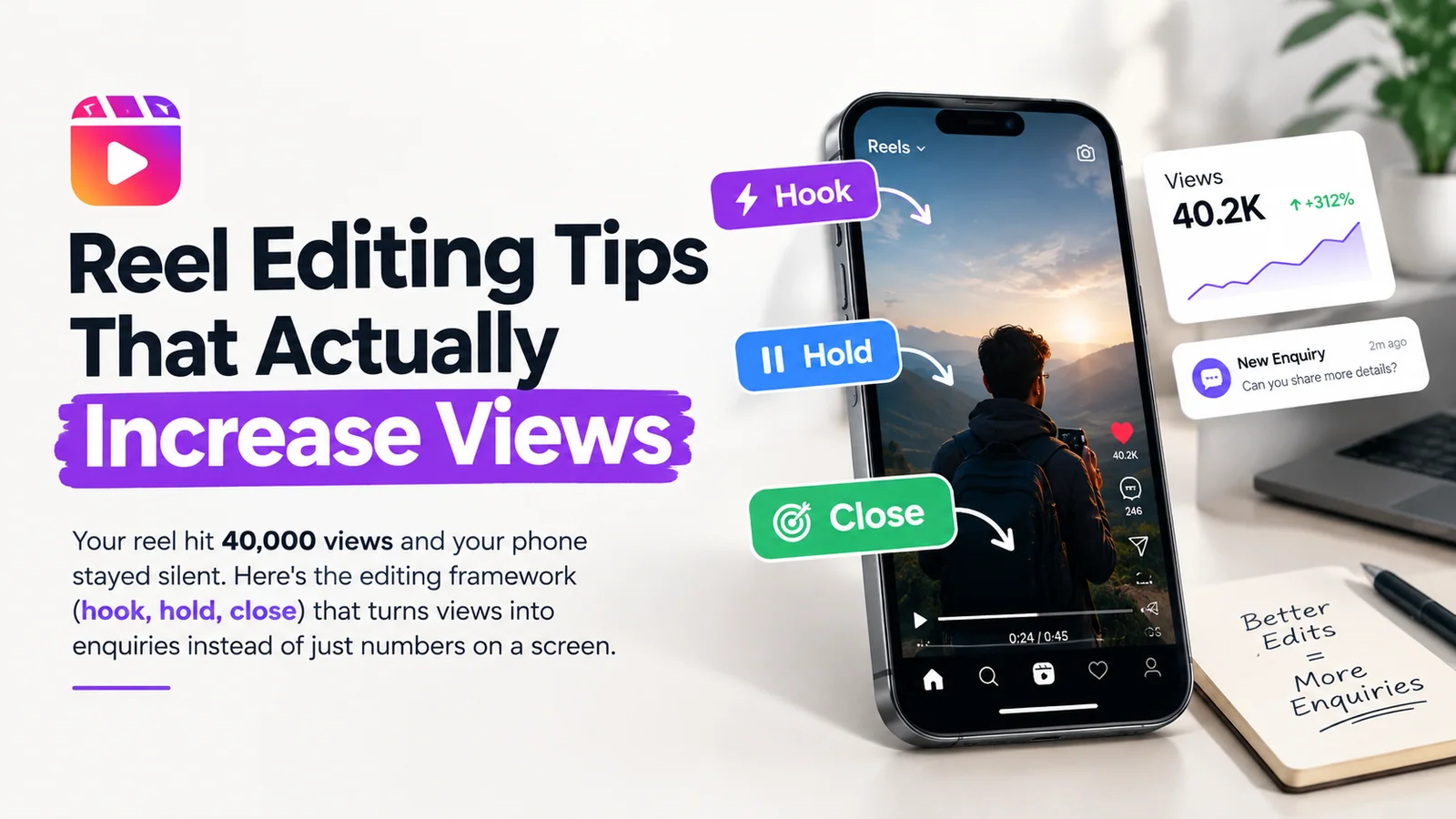
This is one of the most common complaints we hear from business owners doing their own reels, and it's rarely a talent problem. It's usually an editing problem. But not the one people think. The fix isn't "make it prettier." It's understanding what a reel's edit is actually supposed to do at each second, and building toward an outcome instead of a number.
Views Are a Vanity Metric, Enquiries Are the Business
Start by being honest about what a view even measures. Adam Mosseri, who runs Instagram, has said publicly, more than once, that Instagram's algorithm, the system that decides how many people see your reel, leans more on signals like watch time and saves than on raw view counts. A reel that gets rewatched or saved tells Instagram "this was worth someone's time" in a way a quick scroll-past never does. Views can pile up because a reel is oddly hypnotic, or because it autoplayed in someone's feed for half a second before they swiped. None of that tells you whether the person watching had any reason to buy from you.
So the first mental shift, before you touch a single cut, is this: you're not editing for a bigger view count. You're editing for two things: enough watch time and enough saves that the algorithm keeps showing it to more people, and enough clarity that the people it reaches actually know what you sell and how to reach you. Views are the side effect of good editing. Enquiries are the point.
The First 1.5 Seconds Decide Everything
We tell our own design clients this bluntly: we cut until the hook lands in about 1.5 seconds. Not because there's a magic stopwatch rule enforced by Instagram, but because that's roughly how long you have before a thumb decides you're not worth its time. On a phone screen, in a feed full of other reels competing for the same half-second, a slow build-up is a death sentence. Nobody is owed your context. You have to earn the next second before you can earn the ten after it.
A working hook does one of a few things immediately: it asks a question the viewer wants answered ("why does your OPD go quiet after 6pm?", OPD being a clinic's walk-in outpatient section), it shows something visually unexpected (a before/after cut, a close-up that doesn't reveal what it is yet), or it states a specific, slightly uncomfortable claim ("your reel is getting views and zero enquiries: here's why"). What it should never do is open with your logo, a slow zoom into your storefront, or a caption that reads like a brochure headline. Test this yourself: watch your own reel's first 1.5 seconds on mute, with no context, as if you were scrolling past it. If nothing there would make you stop, nothing downstream will save it.
Pattern Interrupts Keep People Watching Past the Hook
Getting the stop is only half the job. The other half is not losing them in the next ten seconds. This is where a lot of well-shot reels fall apart: gorgeous footage, static pacing, and the viewer's thumb drifts back to the feed by second four. The fix is a pattern interrupt roughly every 2 to 3 seconds: a jump cut to a new angle, a quick zoom punch, a caption or text overlay that changes, a sound or music shift, or a swap from talking-head to product shot and back.
You don't need After Effects wizardry for this. A single camera source cut into three different angles, resequenced with jump cuts and a couple of zoom punches in editing, reads as far more dynamic than one long unbroken shot, even though nothing new was filmed. Subtitles that appear word-by-word rather than as one static block do a similar job of keeping the eye moving. The goal isn't chaos for its own sake. It's making sure the eye and the brain always have something new to register, so boredom never gets a foothold before your message arrives.
Every Reel Needs Exactly One Message and One CTA
This is where most reels lose the enquiry even after nailing the hook and the hold. They try to say too much: the product, the offer, the founder's story, three different price points, and a giveaway, all in nineteen seconds. The viewer leaves remembering that it was well-shot and not what to do next.
Every reel should close on one message and one call to action, repeated in the caption so it survives even if someone skips the last second. One message means picking the single thing this specific reel is for: introducing a new service, answering one FAQ, or showing one before/after. Cut everything else. One CTA means one instruction: "DM us for pricing," "book a free 30-minute call, link in bio," or "comment SIZE and we'll send details." Not three options presented as if the viewer will politely choose one. Say it once, say it plainly, and put it in text on screen as well as in voice, because plenty of your audience will watch on mute.
How Long Should a Reel Actually Be
There's no fixed law here, whatever a listicle title implies. As current practice, 7 to 15 seconds is a reasonable range for most reels: long enough to land a hook, hold with a pattern interrupt or two, and close on one message. Short enough that watch-through rates, how much of the reel people actually finish, stay healthy. Chalta hai editing means stretching a reel to 30 seconds because you shot extra footage and didn't want to waste it. That usually costs you completion rate, which costs you the very reach you were hoping the extra footage would earn.
Going longer is fine when the content actually earns it: a real before/after transformation that needs the buildup, a mini case study, a process reveal people are actually curious about. The test isn't "is this under 15 seconds." It's "would I, as a stranger with no stake in this business, watch to the end." If the answer is no, the edit needs cutting, not stretching. This applies whether you're cutting for Instagram Reels or YouTube Shorts. The platforms differ in discovery mechanics, but the attention economics of a vertical, sound-optional, thumb-scrolled feed are close to identical.
The Edit Checklist Before You Hit Publish
Before you export, run the reel through a short gut-check. Watch the first 1.5 seconds alone, on mute, and ask if it would stop a stranger's thumb. Count the pattern interrupts in the first ten seconds. If there's a stretch of more than three seconds with nothing new happening visually, look for a cut, a zoom, or a caption change to add there. Confirm there's exactly one message the reel is trying to land, and cut anything that competes with it, including a second product mention or a second offer. Check that subtitles are burned in and readable at thumbnail size, since a large share of your audience will watch with sound off in a queue, a waiting room, or a meeting. Confirm the CTA appears both on screen and in the caption, worded as a single, specific action. Not "check out our page." Instead, "DM us the word MENU and we'll send today's specials."
None of this needs expensive software. A phone editing app with jump cuts, text overlays, and auto-captions covers most of it. The discipline is in what you leave out, not the tools you use to leave it out.
When Editing Isn't the Problem
Here's the honest part. If your reels are genuinely getting solid views and zero enquiries even after you've fixed the hook, the pacing, and the CTA, the problem might not be the edit at all. It might be that your DM auto-replies are off or slow, so the two or three people who did try to message you gave up waiting. It might be that the reel is entertaining but doesn't actually show what you sell, so viewers enjoyed it and forgot you're a business. It might be that the content is reaching people who were never going to buy. A reel that goes viral with a general audience for entertainment value can rack up views while never touching the tier-2 buyer, someone shopping from a smaller Indian city rather than a metro, or the local patient who was actually your customer.
Sometimes the answer is that you don't need a better edit. You need a clearer offer, a faster reply system, or content aimed at a narrower, more relevant audience. No amount of jump cuts fixes a business problem the reel was never going to solve.
What This Looks Like at Scale
Think about doing this consistently: reels alongside ad creatives, packaging, and print, all drawn by the same hands so your feed, your signage, and your visiting card finally look like one business. The volume adds up fast. That's part of why a design retainer exists: not because any single reel is hard to edit once, but because doing it properly for every post, every month, without the consistency slipping, is a different job entirely. Our own design and video team ships 120-plus creatives and cuts a month across clients precisely because that discipline needs a system, not just good intentions on a Sunday evening.
Reels are also just one piece of a bigger identity, not a fix on their own. When we rebuilt a six-year-old D2C (direct-to-consumer) brand's identity and packaging, the relaunch reels were one part of a six-week rebrand that also touched the logo, the palette, and the packaging. Store conversion moved 40% against the six weeks before, with repeat orders up 18% the following quarter, measured against real store analytics. The reels helped make the relaunch visible. They weren't doing that work alone, and no editing trick would have carried a brand people didn't recognise on the shelf.
If you're a small operation posting two or three reels a month and reading them by feel, you might not need a retainer or an agency at all. The hook, hold, close framework above is genuinely DIY-able with a phone and a free editing app. Where it starts making sense to hand this off is when the volume gets real: when you're trying to keep six platforms consistent, when the reels need to match ad creatives and packaging and a hoarding, or when "I'll edit it this weekend" keeps turning into three weeks of nothing going out at all.
So next time a reel racks up views and your phone stays quiet, don't ask what went wrong with the edit. Ask which second the viewer's thumb moved on, what they were supposed to do next, and whether they even had a reason to.
Questions people also ask
How long should an Instagram reel be to get more views?
There's no fixed length that guarantees views. Most reels that hold attention well run 7 to 15 seconds. That's enough to make one point without losing the viewer. Longer reels can work, but only when the content has earned the extra seconds through story or payoff, not because the algorithm rewards length by default.
What exactly is a "hook" in reel editing, and how long should it be?
A hook is the first visual or line that stops a thumb mid-scroll: a question, a bold claim, an unexpected image, or motion that breaks the pattern of whatever came before it in the feed. It needs to land fast, in roughly the first 1.5 to 2 seconds, before the viewer has decided to move on.
Do more views on a reel actually mean more sales enquiries?
Not necessarily. Views measure attention, not intent. A reel can be entertaining enough to rack up views while giving the viewer no reason or way to act. Enquiries come from a reel that also states what you sell and makes the next step (a DM, a WhatsApp link, a comment) obvious.
How often should you cut or change the shot in a reel?
A pattern interrupt every 2 to 3 seconds (a jump cut, a zoom, a caption change, or a sound shift) is a reasonable rule of thumb to keep attention from drifting once the hook has done its job. It's a guideline for pacing, not a metronome to cut against blindly.
Should every reel end with a call to action?
Yes. A reel without a clear next step leaves even an engaged viewer with nowhere to go. Keep it to one message and one CTA: "DM us for the price list," "link in bio," or "comment SIZE," repeated in the caption so it survives even if the viewer skips the last second.